I’m still not sure how this ad didn’t get made:
Month: January 2009 (Page 6 of 61)
If you watch football long enough, it won’t take you long to realize it’s a brutal game. But how brutal? According to the Center for the Study of Traumatic Encephalopahty (CSTE), football players are suffering massive amounts of brain damage throughout their playing careers.
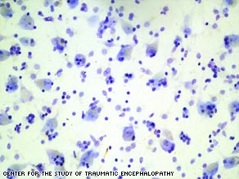
(The top) image of healthy brain tissue. (The bottom image) is brain tissue of a middle-aged football player. It reveals the intense damage from repeated concussions received on the field. According to Dr. Ann McKee, co-director of the Center for the Study of Traumatic Encephalopathy (CSTE), the damage looks similar to that of an 80-year-old with dementia caused by Alzheimer’s disease. The CSTE have found the condition, called chronic traumatic encephalopathy (CTE), in the donated brains of dead NFL players John Grimsley, Mike Webster, Andre Waters, Justin Strzelczyk and Terry Long. From CNN:
“What’s been surprising is that (the damage is) so extensive,” said Dr. Ann McKee, a neuropathologist at the Veterans Administration Hospital in Bedford, Massachusetts, and co-director of the CSTE. “It’s throughout the brain, not just on the superficial aspects of the brain, but it’s deep inside.”
The damage affects the parts of the brain that control emotion, rage, hypersexuality, even breathing, and recent studies find that CTE is a progressive disease that eventually kills brain cells.
The NFL takes steps to try and prevent damage like this from occurring, but clearly it still isn’t enough. A new wave of helmets have come into the league over the past couple of seasons, but it’ll probably be years before tests can be done to measure their effectiveness. Hopefully as technology grows stronger, new equipment will be invented to save players from major injury. But for now, football is still as brutal as it comes.

According to sources at ESPN.com, the Oakland Raiders have chosen Tom Cable to become their full-time head coach. The team hasn’t officially announced the decision yet, but it appears like it’s a done deal.
Cable of course coached the Raiders for 12 games last season after Al Davis fired Lane Kiffin. But before those 12 games, Cable had just three years head coaching experience at the University of Idaho (in which he complied an 11-35 record), which begs the question: is he qualified to take over the mess in Oakland?
Cable coached in the collegiate ranks from 1987 to 2005, mostly as an offensive line coach and as an offensive coordinator. In 2006, he took over as the Falcons’ offensive line coach for one season and then coached the Raiders’ O-line in 2007 and six games in 2008 before taking over as interim head coach after Kiffin was fired.
In 12 games last year, the Raiders went 4-8 under Cable, with impressive victories over the Broncos, Texans and Buccaneers over that span. But the team also showed little to no effort in losses to the Falcons, Chargers and Patriots.
Possibly the main motivation behind the Cable hire was that the players seem to favor him. He has become known as a motivator, which is certainly one of the things that the Raiders need. But can he develop JaMarcus Russell? Can he help Davis build a roster via free agency and the draft? Or is he just another “yes man” that Davis can control and that’s the main reason he got the full time gig? (Remember, Kiffin was fired in Oakland largely because he wanted to do run the team his own way and that never sat well with Davis.)
The key to the Cable hire might be whom the team chooses at the coordinator positions. If Cable can find two respected coordinators to run the offense and defense, then he can do what he does best in keeping the team motivated throughout the year.
Regardless of the overall inexperience he has at the NFL level, Cable deserves a shot because he’s built a good relationship with the players and that could go a long way in Oakland. Now he just has to build a competent staff and hope that Davis doesn’t spend another offseason overspending on overrated players.
 The National Hockey League Players Association (NHLPA) announced during the All-Star Game weekend celebration in Montreal that the current collective bargaining agreement (CBA) between the players and owners would be extended for another two years. This will ensure content with the current labor system in the sport through the start of the 2011-12 season.
NHLPA Executive Director Paul Kelly stated that the players’ unanimously wanted to stay focused on continuing to help grow the game’s popularity in North America. Throw in the current economic climate, and no one in the NHLPA felt it was the appropriate time for the players to enter a complex labor negotiation with management.
Under the current labor agreement, the players have reaped the benefit of being able to become an unrestricted free agent at an earlier age. The average salary per player has risen from $1.8 million in the first post-lockout season to a projected average of over $2 million for this season, and the salary cap has also risen in the same span going from $39 million to almost $57 million this season. The NHL is projecting a marginal revenue growth for the upcoming 2009-10 season.
All the teams in the league breathe a sigh of relief with this announcement, as it will allow them to move forward in their development process by knowing the current labor agreement will be in place for at least two more seasons.
And finally, the biggest winners of all were the fans. They don’t need to worry about the possibility of the league closing its doors again for yet another work stoppage at the end of this season.
 Who says the college basketball regular season doesn’t mean anything? (Kirk Herbstreit and Mike Greenberg, I’m looking at you.)
When Dino Gaudio took over as the head coach at Wake Forest, he immediately announced a change in defensive philosophy. He decided that if the team wanted to become a perennial contender, they had to focus more on that end of the court. He implemented the Pack Defense, created by Dick Bennett, former coach at Wisconsin and Washington State. He spoke with Dick’s son, Tony, as well as Sean Miller, who uses the defense at Xavier.
That change in philosophy paid great dividends tonight, as the #4 Demon Deacons upended #1 Duke, 70-68, limiting the Blue Devils to just 4-22 from long range.
But good defense can’t always overcome bad free throw shooting. Wake Forest led, 61-48, with 8:50 to play. Benefiting from Wake’s 5-10 free throw shooting down the stretch, Duke went on a 20-7 run to tie the game at 68-68. The game should have gone to overtime, but Gerald Henderson, Nolan Smith and David McClure didn’t communicate on Wake’s out-of-bounds play with only a few seconds remaining, and James Johnson sprung free for a way-too-easy layup to win the game. Johnson was positioned to be the goat, as he was outhustled by Jon Scheyer for a rebound on Duke’s previous possession (which set up Gerald Henderson’s game-tying bucket over Johnson).
In the end, these were two very good teams doing battle in the ACC. Wake Forest now has the inside track to a #1 seed with wins over Duke and North Carolina, but the two teams will meet again in Durham on Feb. 22 and may meet a third time in the ACC Tournament.
In other action, #3 Pitt lost to #22 Villanova, 67-57. It’s tough to win any game on the road in the Big East, especially against a ranked opponent like the Wildcats. Reggie Redding led ‘Nova with 18 points as the Wildcats’ defense held the Panthers to just 42% from the floor and 20% from long range.
FOLLOW US!

CATEGORIES
© 2026 The Scores Report – The National Sports Blog
Theme by Anders Noren — Up ↑