Think you can fall asleep once the first round of the NBA Draft is over? Think again. It seems like every year, a player or two from the second round emerges into a solid NBA contributor, eventually developing into an All-Star caliber player. Here is a list of the Top 10 second round picks in the modern era of basketball. (Most people believe that the modern era of the NBA began when the three-point rule was instituted, in the 1979-80 season.) The criteria are simple: how good was the player or if the guy is still playing, how good does he project to be once his career is over? That last part takes a little guesswork, but it makes the list more fluid as the guys currently playing establish their legacy. I also took into account whatever accolades each player won, be they All-Star appearances, All-NBA teams, even All-Defensive or Sixth Man awards. Special consideration was given to those players who were key players on championship squads. After all, winning a ring is what it’s all about.
Let’s start with a few Honorable Mentions:
Players who could still make the list: Monta Ellis, Mo Williams, Mehmet Okur, Stephen Jackson, Daniel Gibson, Paul Millsap, Carl Landry, Brandon Bass, Louis Williams and Ryan Gomes
Older/Retired players who had solid NBA careers: Nick Van Exel, Cliff Robinson, Cedric Ceballos, P.J. Brown, Antonio Davis, Steve Kerr, Vernon Maxwell, Jerome Kersey and Gerald Wilkins
 10. Anthony Mason, 1988, #53 (Portland)
Career Averages: 10.9 ppg, 8.3 rpg, 3.4 apg, .509 FG%
Mason was actually drafted in the third round and was cut shortly thereafter. After playing in Turkey and in the CBA, he was eventually signed by the New York Knicks in 1992 and really blossomed under head coach Pat Riley, becoming (along with Scottie Pippen) one of the league’s prototypical point-forwards several years after Paul Pressey made the position famous. Along with Patrick Ewing, Charles Oakley and Charles Smith, the quartet made an intimidating front line in Riley’s thug-ball system, setting the game back 20 years in the process. A year after losing in the NBA Finals to Hakeem Olajuwon, Mason was named Sixth Man of the Year in 1995. He was later traded to Charlotte, where he was named to the All-Defensive 2nd Team and All-NBA 3rd team, and following a 2001 trade to Miami, Mason was selected for his first All-Star Game. He was then traded again to the Milwaukee Bucks, completely ruining the team’s chemistry that had them in the Eastern Conference Finals the previous season.
Bonus points for… being one scary-looking mofo.
Negative points for… having the reputation of being a general malcontent and chemistry-killer… ruining my beloved Bucks. Great acquisition, George Karl!
 9. Rashard Lewis, 1998, drafted #32 (Seattle)
Career Averages: 16.8 ppg, 5.8 rpg, 1.8 apg, .460 FG%, .390 3PT%
Lewis was drafted by the Sonics out of high school and quickly became one of the team’s best players, averaging 14 points or more each of the last six seasons and 20 points or more the last two years. In the 1998 draft, his hometown team (the Houston Rockets) passed on him three times, instead selecting Michael Dickerson, Bryce Drew and Mirsad Turckan. Ouch! In 2005, Lewis was named to his first All-Star Game. Last summer, the Orlando Magic signed him to a monster contract and he helped lead the team to its first 50+ win season in 12 seasons. He is still just 28, so he could move up the list (or fall off) before his career is done.
Bonus points for… having a great three-point shot for a 6-10 player.
Negative points for… despite being 6-10, he doesn’t rebound very well, he has a questionable post up game and takes almost 30% of his shots from long range. Go inside (at least a little), young man!
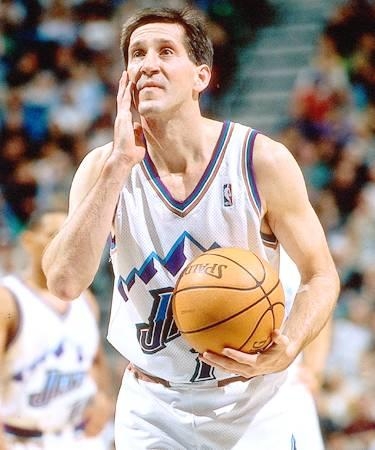 8. Jeff Hornacek, 1986, #46 (Phoenix)
Career Averages: 14.5 ppg, 3.4 rpg, 4.9 apg, .496 FG%
“Horny” (as Utah coach Jerry Sloan used to call him) was truly a pure shooter, a rarity in the NBA. Drafted by the Suns, he was traded to the Sixers (along with Andrew Lang and Tim Perry) for Charles Barkley and later traded to Utah, where he would play seven seasons with Karl Malone and John Stockton, helping the team appear in back-to-back NBA Finals in 1997 and 1998. Hornacek was one of the best free throw shooters in NBA history (13th in all-time FT%), and was in the Top 10 in FT% nine times in his career. He was named an All-Star in his final year in Phoenix, when he averaged 20.1 points, 5.0 rebounds and 5.1 assists while shooting a stellar 51% from the field.
Bonus points for… stroking his cheek three times before every free throw, his way of saying hello to his three children.
Negative points for… giving diminutive white kids everywhere unrealistic hopes of making it to the NBA.
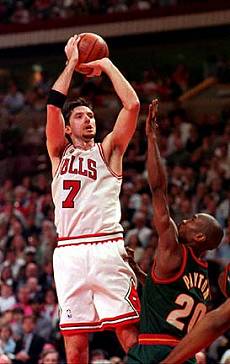 7. Toni Kukoc, 1990, #29 (Chicago)
Career Averages: 11.6 ppg, 4.2 rpg, 3.7 apg, .447 FG%
As a member of the Chicago Bulls, “The Waiter” helped to serve up the team’s second three-peat, winning Sixth Man of the Year honors in 1996. On a team that featured Michael Jordan, Scottie Pippen and Dennis Rodman, Phil Jackson asked Kukoc to spark the team off the bench and he filled the role beautifully. In each of the team’s championship seasons, Kukoc averaged more than 13 points, four rebounds and three assists per game while shooting better than 47% from the field. His career numbers aren’t mind-boggling, but he was still playing at 37 and his minutes declined in his final years, hurting his stats. Playing a vital role on a team that won three titles goes a long way in this league.
Bonus points for… while playing for Jugoplastika Split, winning three European titles in a row (a feat that has never been matched)… winning the title of European Player of the Year three times while playing for Benetton Treviso… having the nicknames “White Magic” and “the Croatian Sensation.”
Negative points for… looking like a duck.
 6. Michael Redd, 2000, #34 (Milwaukee)
Career Averages: 20.5 ppg, 4.2 rpg, 2.3 apg, .452 FG%
In his eight seasons, the former second round pick has gone from a work-in-progress to one of the best scorers in the league. He has averaged more than 22.7 points over the last four seasons and has developed one of the league’s quickest and most lethal jump shots. He is able to make shots both inside (47.7%) and outside (38.8%) the arc. In 2004, Redd was named an All-Star and also made the All-NBA 3rd Team. He holds the record for most three-point field goal attempts made in a quarter with eight in the fourth period against the Houston Rockets in 2002, and he also takes care of the ball – his career turnover rate of 8.32 is the second best in league history.
Bonus points for… being a good citizen, on and off the court…improving his game every offseason… developing into the best player to come out of the 2000 draft.
Negative points for… sketchy shot selection last season… not having enough of a defensive mindset.
 5. Manu Ginobili, 1999, #57 (San Antonio)
Career Averages: 14.7 ppg, 4.0 rpg, 3.6 apg, .454 FG%
San Antonio picked Ginobili late in the second round of the 1999 draft, but he didn’t sign with the Spurs until after the 2002 World Basketball Championship. He helped the Spurs win NBA titles in 2003, 2005 and 2007, and was voted to play in the 2005 All-Star Game. Last season, he was the Sixth Man of the Year and was named to the All-NBA 3rd Team. He is capable of hitting the long-range shot, but he is at his best when he attacks the hole relentlessly. In fact, when the Spurs need a bucket, they are most likely to go to Ginobili, who is able to create contact and score efficiently at the free throw line. With the big nose and the flowing locks, he’s quite a sight on the basketball court.
Bonus points for… being the latest pick on this list, and arguably the biggest steal in draft history… leading the Argentinean national team to a gold medal at the 2004 Olympics, becoming the only player ever to win the Euroleague, an Olympic gold medal and an NBA title… being the human form of a ‘whirling dervish.’
Negative points for… overreacting to any type of contact in the hopes of getting a call, frustrating countless opponents, coaches and fans in the process.
 4. Mark Price, 1986, #25 (Dallas)
Career Averages: 15.2 ppg, 2.6 rpg, 6.7 apg, .472 FG %
Dubbed “too slow” and “too short” for the NBA game, Price was taken by Dallas with the first pick in the second round and traded on draft day to Cleveland, where he spent nine seasons and helped turn the Cavs into an Eastern Conference powerhouse. He was one of the best shooters in league history, and during the 1988-89 season, Price was one of only three players (along with Larry Bird and Reggie Miller) to shoot at least 50% from the field, 40% from the 3-point line and 90% from the free throw line. In fact, he’s the all-time career free throw leader at 90.4%. Price made the All-Star game four times, was selected to the All-NBA 3rd Team three times and the All-NBA 1st Team once, and averaged 15+ points and 7+ assists in seven consecutive seasons. Not bad for a guy that was deemed “too slow” and “too short” for the first round.
Bonus points for… being a six-foot white guy who regularly took over games… having his number (not just his jersey) retired at Georgia Tech, his alma mater.
Negative points for… like Hornacek, giving diminutive white kids everywhere unrealistic aspirations of playing in the NBA.
 3. Dennis Rodman, 1986, #27 (Detroit)
Career Averages: 7.3 ppg, 13.1 rpg, 1.8 apg, .521 FG%
“The Worm” was a perfect fit for the Pistons; his defensive intensity and role player mentality was just what Detroit needed to win back-to-back NBA titles in ’89 and ’90. One of the greatest rebounders in league history, Rodman won five titles in all (two with Detroit and three with Chicago), and was the Defensive Player of the Year in 1990 and 1991. In total, he was named to the All-Defensive Team seven times, he won the rebounding title seven consecutive years, he was named to the All-Star team twice, and was named to the All-NBA 3rd Team twice. Whew!
Bonus points for… sleeping with both Madonna and Carmen Electra, back when it meant something.
Negative points for… starring with Jean Claude Van Damme in “Double Team,” winning three Golden Raspberries (Worst New Star, Worst Supporting Actor and Worst Screen Couple) in the process… often dressing up in drag.
 2. Carlos Boozer, 2002, #34 (Cleveland)
Career Averages: 16.9 ppg, 9.9 rpg, 2.4 apg, .541 FG%
Boozer made a huge leap in the 2006-07 season, averaging 20.9 points and 11.7 boards in his first healthy season since ’03-’04. He was named to his first All-Star Game and led the Jazz to the Western Conference Finals. Last season he averaged 21.1 points and 10.4 rebounds and was named to another All-Star Game and his first All-NBA team (3rd). Boozer is just 26, so he still has a lot of great years ahead of him. He looks like a perennial All-Star and All-NBA player, which is why he’s ahead of Rodman on this list. He has taken a lot of criticism for the way things ended in Cleveland, but the Cavs shot themselves in the foot by not picking up his option (a mere $695K!) which would have given the team the ability to go over the cap to sign him a year later. It’s a “he said/she said” situation with one side (the Cavs) saying that there was an illegal verbal agreement in place and the other side (Boozer) saying there wasn’t.
Bonus points for… having to deal with being vilified (if he didn’t make a verbal agreement)
Negative points for… leaving the Cavs in a lurch (if he did make a verbal agreement)
 1. Gilbert Arenas, 2001, #31 (Golden State)
Career Averages: 22.8 ppg, 4.2 rpg, 5.5 apg, .428 FG%
Arenas was the second pick in the second round of the 2001 draft and used his draft position as motivation when he entered the league. He was named to the All-Rookie team in his first year and won the Most Improved Player in his second season. Two years later, in his first year in Washington, Arenas was named to his first of three All-Star games. He was named to the All-NBA 3rd Team in both 2005 and 2006, and to the All-NBA 2nd Team in 2007. He missed most of last season with a knee injury, so it will be interesting to see if Arenas can continue his remarkable career path going forward. If his game takes a dip, he’ll surely fall down this list.
Bonus points for… wearing the number “0” because that’s how many minutes his critics said he’d play at the University of Arizona… once taking a shower at halftime in full uniform… throwing his jersey into the stands after every game… Wizards fans coining the term “Gilbertology,” which is used to describe his quirky behavior both on and off the court.
Negative points for… once, during a regular season game, trying to make a free throw by bouncing the ball off the court first.
There are some great players on this list, even a few of the so-called “franchise” players. What’s the common theme? Size — six are guards. The other four are forwards, and none of them are traditional back-to-the-basket big men. Teams will keep selecting guys like Kwame Brown, Michael Olowokandi and Sam Bowie early in the first round, but I’ll take the players on this list any day.
Woods slithered a 12-foot birdie putt into the right side of the cup at No. 18 to pull even with Mediate on Sunday’s 72nd hole and force one extra day of adrenaline at Torrey Pines.
