Page 808 of 2957

Patriots make wise decision to place Wes Welker on PUP list

HOUSTON - JANUARY 03:  Wide receiver Wes Welker #83 of the New England Patriots is tended to by medical personnel after injuring his leg against the Houston Texans at Reliant Stadium on January 3, 2010 in Houston, Texas.  (Photo by Bob Levey/Getty Images)

When fantasy football owners woke up this morning and saw the news that the Patriots had placed receiver Wes Welker on the Physically Unable to Perform list, their first reaction was likely to adjust their draft boards. (Actually, their first reaction was probably to crap themselves and then adjust their draft boards, but that’s gross so just forget I wrote it. For realsies – just put it out of your mind.)

But the Welker decision was like most decisions Bill Belichick and the Patriots have made throughout the years: smart.

Welker knows how to catch a screen pass in Belichick’s offense. He’s been doing it since 2007 and he’s quite good at it, might I add. So there’s no reason to rush him back for the start of training camp, even if he’s medically cleared to start practicing.

Training camp is mostly beneficial for three kinds of players: Rookies, veterans who are unfamiliar with the offense or defense, and players who are out of shape. Welker isn’t a rookie, he knows Belichick’s offense like the back of his hand and even though he might not be in game shape, he’s been working out for months and probably isn’t the second coming of Terrence Cody.

Seven months ago he shredded his knee, which some in the medical field (dentist, I believe) claim takes time to heal. Welker can come off the PUP list at any point over the next couple of weeks, so if the Patriots deem him ready to go, then they can active him and get him ready for season.

Assuming he doesn’t suffer any setbacks in his rehabilitation, then there should be no panic in Beantown.

Dez Bryant says he was unaware of shoulder pads tradition

ARLINGTON, TX - JANUARY 9: Roy E. Williams #11 of the Dallas Cowboys is tackled by Sheldon Brown #24 of the Philadelphia Eagles after gaining 17-yards on a second quarter catch during the 2010 NFC wild-card playoff game at Cowboys Stadium on January 9, 2010 in Arlington, Texas. (Photo by Jamie Squire/Getty Images)

After being scrutinized for refusing to carry teammate Roy Williams’ shoulder pads following a recent training camp practice, Cowboys’ rookie Dez Bryant says he didn’t know that the gesture was a tradition in the NFL.

“I didn’t know nothing about no tradition,” Bryant said. “The only thing about me … when I try to do something right, ya’ll try and turn it negative and I don’t feel like that’s right. I’m trying my best to do the right thing but it seems like I can’t do the right thing because every little thing that I do ya’ll watching it and try to make a big deal out of it.”

Some are trying to make a bigger deal out of this situation than it really is, but Bryant says that everything between him and Williams is fine now, so the issue should be dead. Bryant wasn’t aware of the tradition and now he is. Griping.

Like I wrote yesterday, I think Williams should carry his own pads seeing as how he’s stealing from the Cowboys with that ridiculous salary of his. In fact, I think both Williams should have to carry Drew Pearson’s shoulder pads.

Chris Paul still wants out

Ken Berger of CBSSports.com says that what we saw from the Hornets’ brass on Monday was a ‘smokescreen’:

“The telltale thing is that Chris Paul won’t comment publicly other than what was released about it,” said a person familiar with Paul’s strategy. “Leon Rose didn’t come out and say, ‘Chris is happy in New Orleans.’ If he was happy, they would’ve said that. … The only way they can get close to full value is to say, ‘You guys can’t make trade demands.’ They’re orchestrating this thing to likely move him.”

The Hornets, meanwhile, have been looking at Orlando, Charlotte and New Jersey as potentially attractive trade partners once the firestorm settles down, according to one of the people with direct knowledge of the Hornets’ strategy. Two other sources familiar with the situation confirmed prior discussions involving the Bobcats and Nets and said those talks are expected to advance in the coming days.

Berger has emerged as one of the league’s more plugged-in writers, but one has to wonder how close this ‘person familiar with Paul’s strategy’ actually is to the man himself.

Paul doesn’t have a no-trade clause in his contract, so the Hornets can send him wherever they want. The Nets are interesting trade partner due to the upside of Derrick Favors. I doubt New Jersey would give up Brook Lopez, but a deal that included Favors along with salary cap relief might be appealing to the Hornets.

As for Charlotte, it just doesn’t look like the Bobcats have a young piece on the level of Favors (or the Gallinari/Randolph combination from the Knicks). Tyrus Thomas has spent most of his potential capital and Gerald Wallace is getting on in years.

Favors can’t be traded until August 15, though an agreement in principle could be made sooner than that. If the Nets can come out of the summer with a core of Paul and Lopez (while possibly turning Devin Harris into some help on the wing), it will salvage an otherwise disappointing summer.

Terrell Owens to the Jets? Pass.

ATLANTA - DECEMBER 27: Terrell Owens #81 of the Buffalo Bills against the Atlanta Falcons at Georgia Dome on December 27, 2009 in Atlanta, Georgia. (Photo by Kevin C. Cox/Getty Images)

T.O. to NY? It kind of has a nice ring to it, but that’s about all it has.

With Santonio Holmes set to miss the first four weeks of the season due to a suspension, signing Owens seems like a logical move for the Jets on paper. But in reality, what happens after Holmes returns? Owens goes home?

The pecking order in the Jets’ passing game this year will go a little something like this: Holmes (once he returns), Braylon Edwards, Jerricho Cotchery, Al Toon. As you can see, there aren’t enough passes to go around if T.O. were thrown into the mix, especially when you consider that Mark Sanchez is still trying to develop as a passer.

Which is another thing: T.O. must be avoided so that Sanchez has room to grow. The Jets’ passing game is a work in progress and Owens would have plenty to groan about if a) he wasn’t getting enough touches and b) Sanchez started to struggle.

The fastest way to stunt a quarterback’s development is to play him before he’s ready. The second fastest is having Terrell Owens on the roster.

Kudos to Mike Tannenbaum for considering all of his options (the Jets were the same team that showed a small interest in JaMarcus Russell before he was busted sippin’ the syruuuup), but in the end there just isn’t enough room for T.O. in the Big Apple.

Does baseball betting need saving?

Chad Millman of ESPN The Magazine certainly thinks so, which is why he came up with this idea:

I hereby propose bookmakers adopt what I call the RHiD line, pronounced rid, which considers runs, hits and defense to create a point spread.

First, we need a new system to create power ratings for each team. In football the difference between two teams’ power ratings is the baseline for creating a point spread. I’m suggesting bookmakers build an MLB version based on this formula: Per-game average of a team’s runs and hits minus the hits and runs it allows. The number created is now big enough to build a spread.

As in football, though, that would be just a starting point for bookmakers. This is where their handicapping comes into play, as they adjust the spread for factors such as starting pitcher, location, injuries, slumps, bullpen strength, etc.

And how do you bet on it? Well, you’re looking at the difference in the total number of runs and hits accrued in the game.

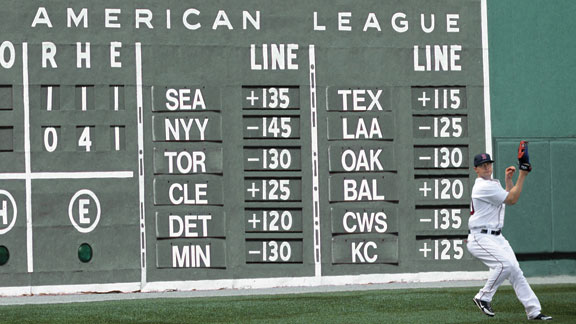
His argument is that the +240 and the -285 that we see next to MLB team names is too confusing for squares, so adopting some sort of a point spread like football would increase interest. (Instead of seeing Yankees -275, we might see Yankees -8.5.) He also believes that awarding points for hits would keep bettors interested into the later innings. The game might be lost, but that doesn’t mean that the trailing team can’t rally to cover the spread.

What do you think?

« Older posts Newer posts »