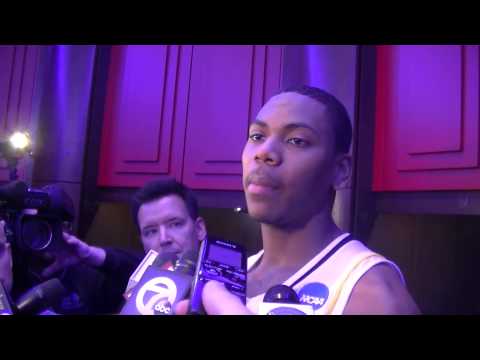
March Madness is a great time of the year for die-hard sports fans and casual fans alike. The close games and the upsets provide plenty of drama on the court, and every year we have new heroes that come out of nowhere. It’s always amazing to see a young kid in his first NCAA tournament become a household name overnight with a stellar performance on the big stage.
After day one yesterday (I don’t count the Wednesday games), we already have some freshman making a splash, and we have others we can expect to hear from today as well.
Fourth-seeded Michigan streaked to a 71-56 win over 13th-seeded South Dakota State on Thursday night, and not surprisingly, freshman phenom Glenn Robinson III had plenty to do with the win. Robinson scored a team-high 21 points, chalking up a whopping 17 in the second half, and he also grabbed six rebounds. His three three-pointers in the second half really fueled Michigan. The Wolverines are very young, so Robinson and the other freshman will have to come up big for this team to go far in the tournament. They wilted in the Big Ten tournament, but maybe that adversity will get them ready to make a run now.
Freshman Gary Harris of Michigan State had a solid night as the third-seeded Spartans defeated 14th-seeded Valparaiso 65-54. Harris wasn’t the leading scorer, as Derrick Nix dominated while dropping 23 points and a career-high 15 rebounds, but Harris was making jumpers as he contributed 10 points to the winning effort. With the 6’ 9” and 270 pound Nix powering the offense from the inside, Harris and Keith Appling can stretch the defense by making outside shots. On a good team like Michigan State, a freshman like Harris doesn’t have to be the star. He just has to know his role and do his job.
Today will feature a number of talented freshman making their tournament debut, and Shabazz Muhammad will be getting a ton of attention as the sixth-seeded UCLA Bruins take on the eleventh-seeded Minnesota Gophers. Muhammad has versatility on offense as he averaged just under 18 points per game while averaging over 5 rebounds per game. He is very effective down low but he also shot 40 percent from the three-point line. With guard Jordan Adams suffering a broken foot, there will be plenty of pressure on the freshman to step up on the big stage. The Pac-12 is off to a great start in the tournament which has silenced some critics, but we’ll see if UCLA can get past a Big-10 team in the first game.
The Kansas Jayhawks are a number one seed so we can’t expect too much drama on Friday in their opening game, but it will be interesting to see how freshman Ben McClemore looks in his tournament debut. This guard averages 16.4 points per game. He’s deadly shooting from the outside, and we’ve seen in the past that hot shooting can propel a team to the Final Four. McClemore is shooting 44 percent from three-point land. This kid could be a top pick, if not the top pick, in the NBA draft so the pressure goes well beyond a potential Kansas run to the title. You never know just how good a player can be until he’s tested at crunch time, so it will be fun to see what this kid can do.
We all love to focus on points and stats when evaluating players, but of course the game of basketball can’t be simply defined by stats. Indiana has a real shot at a national title, and Yogi Ferrell is a big part of that success. The freshman point guard has solid stats with 7.8 points and 4.2 assists per game, but his leadership and solid ball-handling make life much easier for stars like Cody Zeller and Victor Oladipo. There’s every reason to believe this kid will carry this composure into the tournament. James Madison shouldn’t pose much of a problem in the first game but then the real fun begins.
Enjoy the games and hopefully we’ll see some smiles on the faces of these young faces as they march through this incredible tournament.
1. The Percy Harvin trade was outstanding for the Seahawks. They landed a proven playmaker for a first-round pick that may-or-may not wind up being a valuable piece, a seventh-rounder that probably would have been a long-shot to make an already stacked roster, and a third-round selection in 2014 that may-or-may not turn into a solid role player. It’s clear that Harvin wore out his welcome in Minnesota and the Vikings did what they had to do in order to rid themselves of the headache. But this is a dynamic, versatile player that adds a much-needed element to Seattle’s offense. He did miss seven games last season due to an ankle injury, but he missed only three games in the three years prior and his migraine issues have seemingly been resolved. (After being diagnosed with sleep apnea in 2010, he hasn’t suffered a migraine in two year.) With Harvin joining Russell Wilson, Marshawn Lynch, Sidney Rice, Zach Miller and Golden Tate, I’d match the Seahawks up against any other offense in the NFC right now.
2. Speaking of the Seahawks, the signing of Michael Bennett was a shrewd move by Pete Carroll and John Schneider. Bennett wasn’t impressed with the offer he received from the Buccaneers so instead of being patient while testing the market, he accepted what essentially was a one-year “prove it” deal at $5 million. He had nine sacks with Tampa Bay last season and is versatile enough to play end or tackle in a 4-3 alignment. He more than makes up for the loss of Jason Jones (Lions) and after signing Cliff Avril to a reasonable two-year, $15 million contract, Seattle is prepared from a pass-rushing standpoint to get by while Chris Clemons (ACL surgery) is on the mend. Once Clemons returns, he’ll join a defensive line that features Bennett, Avril and former first-rounder Bruce Irvin, who finished with eight sacks last season as a rookie.
3. After some initial confusion, the Patriots signed Danny Amendola before Wes Welker agreed to terms with the Broncos. He also received less money per year than Welker, which further proves that Bill Belichick and his staff coveted Amendola from the start of free agency (as opposed to countering Denver’s decision to sign Welker). New England was wise to tie up $2.5 million of Amendola’s contract in per-game roster bonuses, meaning the oft-injured receiver will need to stay healthy if he wants to fully cash in on his new deal. Considering he’s caught over 100 passes in five of the last six seasons, it’s almost ridiculous to think that the Pats have replaced Welker. But by signing Amendola, they acquired a player with a similar skill set that is also four years younger. As far as production goes, Welker has been in a league of his own since 2007 but Amendola arguably owns a better pair of hands and has more than enough short-area quickness to play the slot in Josh McDaniels’ offense. Amendola just needs to stay healthy or his value will be greatly diminished over the course of his contract in New England.
4. Considering Brian Hartline led the Dolphins in receiving last season, it’s hard to argue why Jeff Ireland spent a large portion of his cap space on Mike Wallace. He gives Miami’s offense something it desperately needed: A playmaker with the ability to take the top off a defense. But did Ireland really improve his defense or did he make slight upgrades while also spending more money? Both Philip Wheeler and Dannell Ellerbe are solid players but Ireland spent a combined $56 million to acquire them on the open market. In one fell swoop, he also released Karlos Dansby and Kevin Burnett, who were productive last season for Miami’s defense. It’s not as if linebacker was a need coming into the offseason – Ireland just shifted players around and by doing so, spent more money in the process. Given the mess that are the New York Jets and Buffalo Bills, the Dolphins will likely be the only threat to the Patriots in the AFC East next season. Again, it’s not as if Miami hasn’t made upgrades to its roster. But these are hardly calculated decisions by Ireland, whose future in Miami could rest on the moves he made last week.
5. It’s laughable that some are questioning the Falcons’ decision to sign Steven Jackson when they could have just kept Michael Turner. These same folks point to both players’ production over the last four years and the fact that Turner has racked up 60 touchdowns since 2008 compared to Jackson’s 26 TDs over that same span. But Turner’s burst and acceleration have evaporated, and he no longer can create on his own. Too often he would run into the backs of his offensive linemen last year and managed a paltry 3.6 yards per carry. Jackson has lost a step over the years but he still displays some quickness and the ability to beat defenses on the edge. Monetarily-speaking, the two players aren’t comparable either. Turner was set to make $6.9 million in his final year with the Falcons, while Jackson signed for a reasonable $12 million over three years. (Of the amount, only $4 million is guaranteed.) For those that worry about touchdown totals, keep in mind that Turner received 51 red-zone opportunities last season with Atlanta, compared to Jackson’s 27 with St. Louis. Considering Dirk Koetter used Turner as his goal-line battering ram last season, Jackson will have more than enough opportunities to reach pay dirt in 2013. More importantly, he’ll also give Matt Ryan and the dangerous Atlanta offense increased production while on its way to the end zone.
6. The Bears took somewhat of a gamble by signing former Saint Jermon Bushrod to a five-year contract on the opening day of free agency. Bushrod was a top-10 tackle in 2011 but his play dipped last season. According to Pro Football Focus, Bushrod allowed a whopping 46 quarterback hurries, eight QB hits, and four sacks. The hurries and QB hits were more than Chicago’s 2012 left tackle J’Marcus Webb (5 QB hits, 29 QB hurries), although the latter allowed three more sacks. If Bushrod can return to his 2011 form, the Bears will have upgraded the blindside protection of Jay Cutler. But if 2012 wasn’t an anomaly for Bushrod, then Chicago will continue to have a real problem on its hands upfront. They’re still deciding what position 2011 first-round bust Gabe Carimi will play (Chris Williams 2.0, anyone?), and if Webb performs as poorly on the right side next year as he did on the left, Cutler’s days of being under constant duress will live on. Phil Emery still has a lot of work ahead of him when it comes to re-building the mess that Jerry Angelo left him along the offensive line.
7. The $38.5 million over five years that the Rams handed tight end Jared Cook was a lot to give a player that has never caught 50 passes in a single season. (His highest reception total came in 2011 when he caught 49 passes for 759 yards.) But Jeff Fisher drafted the former South Carolina product and as long as St. Louis makes him one of the focal points of its offense, chances are he’ll be worth the price tag. But it’s hard to blame fans for being frustrated after the Seahawks landed Harvin and the 49ers gave up a late-round pick for Anquan Boldin. They look at the current depth chart at receiver and wonder, ‘Is that it?’ The key is Brian Quick. If he develops into the player the Rams envision he’ll be when they selected him at No. 33 overall last April, then fans will take comfort in the fact that the team didn’t part with multiple picks and $25 million in guaranteed money for Harvin. Chris Givens is already entrenched as a playmaker on one side and with Cook testing defenses down the seam, the Rams really only need that outside-the-numbers weapon to make their passing game hum. In a perfect world that player will be Quick, and then St. Louis could supplement its depth at receiver by drafting another wideout or acquiring a veteran this spring. (Don’t rule out Nate Washington, who the Titans might release in the coming weeks.) If the Rams missed on Quick, then the present fears will be amplified down the road.
8. Some of the contracts handed out to offensive linemen this week were staggering. I mentioned Bushrod’s five-year, $36 million deal, but there were more head-scratching decisions made by other NFL front offices. Andy Levitre is a solid player and the Titans needed to upgrade their offensive line this offseason. But $46.8 million is an astounding figure for a guard. Sam Baker has only had one productive year since the Falcons reached on him in the first round of the 2008 draft, yet they decided to hand him $41.5 million over six years. With some of the money that has been thrown around in free agency thus far, you can’t blame Jake Long for waiting until he receives the offer he wants.
9. Jets owner Woody Johnson didn’t exactly squash the notion that cornerback Darrelle Revis would be traded at some point this offseason. “No team is just one player away, maybe with the exception of the quarterback,” Johnson told reporters. “You can’t be distracted by one player. You have to look at everything.” Johnson went on to say that the team would like to have Revis back, but “it depends.” In typical Jets fashion, it’s unlikely that they get the best of this current situation. Revis is coming off an ACL injury and thus, his value has never been lower. The Jets are also in cap hell because of former GM Mike Tannebaum, so other teams are well aware that New York doesn’t have the cap space to pay Revis what he wants long-term. With Mark Sanchez under center and Rex Ryan seemingly a dead man walking, there appears to be zero hope on the horizon for “Gang Green.”
10. In any other offseason, a team that needed to fill not one, but two holes at safety would be in full panic mode right now. But the Rams remain in a great spot despite having multiple holes to fill in their secondary. That’s because their options remain plentiful, both in free agency and the draft. Bernard Pollard, Michael Huff, Ed Reed, Kerry Rhodes, Gerald Sensabaugh, Charles Woodson and Tom Zbikowski all remain unsigned, as does Quintin Mikell. A combination of Pollard and either Kenny Vaccaro or Matt Elam would offer an instant upgrade over what St. Louis had at safety last year, provided that Vaccaro or Elam panned out, of course. And the Rams could do much worse than to bring back Mikell for cheap and land a safety in the draft to play centerfield. While it’s a bit unsettling to have clear needs on either side of the ball not addressed quickly in free agency, Jeff Fisher and Les Snead would really have to drop the ball not to land two quality safeties over the next two months.
Michigan’s Tim Hardaway Jr. and Glen Robinson III will both have to play at a very high level in March in order for the Wolverines to live up to expectation.
Fortunately for them they are both very close to people who have experience playing at a high level. They are both sons of (and named after) former NBA All-Stars.
Tim Hardaway Sr. played college basketball at UTEP before coming to the NBA. Once he reached the professionals he made a name for himself as a scoring guard who could also initiate the offense. He played for a number of NBA teams, most notably the Miami Heat where he developed a strong on-court chemistry with Alonzo Mourning.
But of all the things that Tim Hardaway will be remembered for none will stand above his killer crossover dribble. Some say Hardaway not only had the best crossover in the NBA, but also revolutionized it in a way that made it a mainstream move for guards. Allen Iverson, Steve Nash, Chris Paul, Russell Westrbook; none of them could claim to have a better crossover than Hardaway.
While Hardaway Sr. needed to use the crossover to his advantage to compensate for a lack of height, his son surprisingly grew to be six inches taller than his famous father. Hardaway Jr. grew up playing one-on-one against his dad. His competitive spirit led him to eventually beat him when he was in ninth grade, a sign that he was destined to be one heck of a player.
Hardaway Jr. is averaging nearly 15 points and five rebounds on the season.
Glen Robinson went to Purdue University and eventually made a name for himself in the NBA as a tough-nosed scorer. He was a two-time All-Star and earned himself the nickname “Big Dog.”
His son irked many fans of Robinson’s alma mater, Purdue, by choosing to attend Big 10 rival Michigan. He reinforced those feelings by scoring 12 points and grabbing nine rebounds when Michigan faced off against the Boilermakers.
Robinson III is about the same height as his dad, but some might argue he is an even better athlete. Only a freshman, Robinson has yet to announce whether he will be declaring for the NBA draft. If he chooses to jump ship he will have a chance at being a lottery pick as many scouts like his potential as a defender/rebounder/finisher. He may not generate the type of hype RGIII of the NFL did, but GRIII will be a name that we will likely hear for quite some time.
Both young men will get their chance at expanding on their fathers’ NBA legacy at some point, but right now they are both huge reasons why Michigan should be considered a favorite to win the NCAA Tournament.
Led by the two prodigies and Trey Burke, who ironically was hardly recruited by most Big 10 schools yet might be the team’s best player, the Wolverines will be a tough draw for anyone matched up with them.
1. How about Roger Goodell pouring a big cup of antifreeze on everyone’s fun this past weekend? Due to a rule change that allowed teams to gauge the interest of prospective free agents, football fans hovered around Adam Schefter’s Twitter page thinking that free agency was essentially going to start at Midnight on Saturday morning. But Goodell’s memo to teams earlier that day killed everyone’s buzz. Here’s part of the memo, tweeted by Schefter that night: “Clubs are advised that prior to the beginning of the new League Year it is impermissible for a club to enter into an agreement of any kind, express or implied, oral or written, or promises, undertakings, representations, commitments, inducements, assurances of intent or understandings of any kind concerning the terms or conditions of employment offered to, or to be offered to, any prospective Unrestricted Free Agent for inclusion in a Player Contract after the start of the new League Year.” Deathly afraid of tampering, can you imagine how those conversations went on Friday night between teams and free agents? “Hi Mike Wallace, this is Miami Dolphins general manager Jeff Ireland. I just wanted to call and see if you liked the color teal in combination with white and a splash of orange. Yeah, no, I’m not asking you if you want to be a member of the Dolphins. That would be tampering. I’m specifically asking you about color scheme. You do like that color scheme? How about Joe Philbin? Do you like Joe Philbin’s face? Maybe you’d like to see more of Philbin, say, on a daily basis in the fall? Grrrrrrrrreat. Do you also hate purple and the entire state of Minnesota like most reasonable human beings do? Excellent. I’ll see you and your agent at 4:00PM ET on Tuesday then…”
2. People are getting caught up in whether or not the Chiefs should draft Luke Joeckel with the first overall pick when they just placed their franchise tag on Branden Albert. While it would be unprecedented for a team to draft a right tackle with the first overall pick, it doesn’t mean that Kansas City will shy away from arguably the safest prospect in this year’s class. Albert was one of the best pass-blocking offensive tackles in the league last year, but he also missed three games due to a back injury and who knows if the Chiefs will be able to lock him up long term. They could draft Joeckel, play him at right tackle and then re-asses the situation a year from now. If Albert’s back once again becomes an issue or the two sides can’t agree on a long-term deal, then the Chiefs have their left tackle of the future in Joeckel. If they lock Albert up long-term, then at worst they have two book-end tackles for the next six-plus years. Considering defensive coordinators constantly move pass rushers around in effort to create mismatches, that’s not exactly a worst-case scenario. And with no true No. 1 overall talent in this year’s draft, there’s no reason to bypass Joeckel with the top pick just because he could wind up playing right tackle.
3. The best thing for both the Jets and Darrelle Revis is if the cornerback drops off the map and shows up to OTAs healthy and in shape. Owner Woody Johnson isn’t being cheap – he just can’t pay Revis what he wants long-term because his former GM put the team in cap hell by handing out ridiculous contracts to players like Mark Sanchez. And since the Jets can’t afford him, Revis could help himself by not destroying his own trade value. This includes avoiding telling the media that it would be “awesome” to play for the 49ers and reiterating how you want to be the highest paid defensive player in the league. Potential trade partners are already leery about Revis’ knee, parting with premium draft picks, and clearing the necessary cap space to sign him long term. He doesn’t need to provide teams with more reasons to tell the Jets ‘thanks but no thanks.’
4. Percy Harvin’s situation in Minnesota seems combustible, but GM Rick Spielman has wisely suggested that the disgruntled wide receiver isn’t going anywhere. Some fans have opined that Spielman should trade Harvin and then sign a free agent receiver like Mike Wallace or Greg Jennings. But the Vikings are on the rise and thus, parting ways with a playmaker makes little sense. He’s already under contract and the team could potentially line up next year with Harvin, Jennings, Jarius Wright, Adrian Peterson and Kyle Rudolph, as opposed to some combination of Peterson, Rudolph, Jennings, Wright and an unproven rookie. And maybe a veteran like Jennings could have a profound impact on Harvin, who has seemingly alienating himself from coaches and teammates. While the defense and offensive line proved to be underrated, the Vikings made the playoffs last year almost solely riding Peterson’s coattails. Unless the situation is so bad that the team needs to wash its hands completely of Harvin as soon as possible, addition is key – not subtraction.
Based on this article, Keith Olbermann would like to be back, but it doesn’t sound like the folks at ESPN are holding their breath waiting for him to return.
Frankly, it doesn’t make sense, unless they give him a shot doing documentaries. ESPN is a huge business, and Olbermann is too much of a wild card. They don’t need him.