Category: World Cup (Page 7 of 7)

To axe or not to axe? FIFA’s referee dilemma.

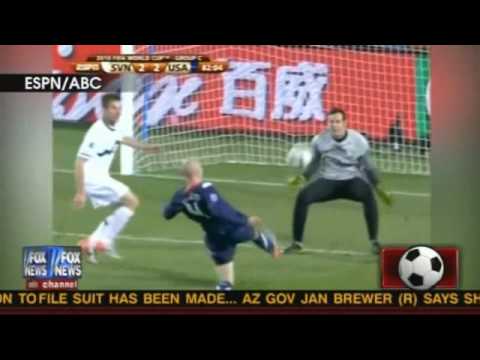
Koman Coulibaly is a name which most of us aren’t familiar. In fact, we probably won’t remember it even after the 2010 World Cup has finished. Simply put, for the next couple of days, Coulibaly will be known as the referee who called a phantom penalty against the United States when the team scored on a direct kick in their match versus Slovenia. Down 2-nil at the beginning of the second half, the U.S. squad unfathomably rebounded with goals by Landon Donovan and Michael Bradley. In the 86th minute, the team suddenly struck the dagger into Slovenia with Maurice Edu’s goal off Donovan’s free kick. But it was not to be, as Coulibaly called a foul…not on Slovenia — whose team member was giving Bradley a FIFA-endorsed Heimlich during the play — but on the U.S. Video evidence proves the call was bogus — so much so, in fact, that FIFA is mulling suspending Coulibaly from officiating for the rest of the tournament.

From ESPN.com:

After the match, Donovan said he asked the referee what the call was but did not get an answer.

“We asked the ref many times what it was or who it was on and he wouldn’t or couldn’t explain it,” Donovan said. “I don’t know what to think of the call because I didn’t see any foul, just a normal free kick and a goal.”

Referees must submit a written report to FIFA after each match, but it is not specified in the rule that he must fully explain a ruling such as this.

FIFA refereeing rules state: “The referee shall hand over to the FIFA general coordinator a match report at the stadium immediately after the match. On the report form the referee shall note all occurrences such as misconduct of players leading to caution or expulsion, unsporting behavior by supporters and/or by officials or any other person acting on behalf of an association at the match and any other incident happening before, during and after the match in as much detail as possible.”

The U.S. team has been besieged with questions why soccer referees don’t publicly explain controversial decisions, as umpires and referees do in U.S. sports.

I take a rather harsh stance when evaluating referees. You know, it is all they do. They attend the seminars and classes to get better, but at the end of their 5-hour work day, their job description is still defined as being a fan with a whistle. While we shouldn’t crucify one to represent the whole, calls such as this are simply inexcusable.

The part that confuses me is that there’s no accountability in FIFA. If the U.S. ends up missing the knockout round, fans may never get an explanation, per FIFA’s outdated protocol. That’s just the way it is. Well, the way is infantile.

Coulibaly needs to go, and take some time to fully understand what’s expected of him as a World Cup official. And yes, I’ll say this as fair-weather soccer fan. Because it matters now.

Peter King outraged over blown call in U.S. draw vs. Slovenia

Peter King is hopping mad about the blown call during Friday’s draw between the United States and Slovenia at the World Cup.

Here’s King’s explanation of the play:’

With the score tied at 2 in the 86th minute, the United States had a direct kick on the Slovenian side of the field. There was much pushing and shoving in front of the goal, both before the ball was in the air and while it flew toward the net. Replays showed three American players being bearhugged by Slovenians — and Americans, in the case of at least two scrums, hugging back. But in the case of an earlier hero, midfielder Michael Bradley, Slovenian Aleksander Radosavljevic did his best Ray Lewis imitation, practically dragging Bradley down just feet from the goal. As the ball fell to earth, American sub Maurice Edu pounced on it, flicking it hard into the net for what appeared to be the winning goal. But in his first World Cup game, referee Koman Coulibaly, from the landlocked West African country of Mali, ran into the fray and blew off the goal.

King is mostly upset that Coulibaly didn’t explain why there was a penalty and which player it was on.

At least four Americans tried to find out what the call was. But Coulibaly, who, according to several U.S. players was all but mute during the game (a rarity in world-class games, they say), didn’t inform either side what call he made. We still do not know what the infraction was that Coulibaly called, and under the idiotic rules of FIFA, Coulibaly doesn’t have to say what the infraction was. He might go to his grave with it.

“Who knows what it was?” said the man of the match, Landon Donovan of the United States. “I am not sure how much English he spoke, or if he spoke English. But we asked him several times in a non-confrontational way. He just ignored us.”

The call was awful. But in all sports, when hugely controversial calls are made — the Tuck Rule call by Walt Coleman in the Raiders-Patriots playoff game nine years ago, the Jim Joyce ruination-of-the-perfect-game this month — at least we know what the call is. Here, millions of people staring at TVs around the world are still asking, “What’s the call?”

So I asked Bob Bradley in the American press conference: “Isn’t something like this a bit of an outrage in a game of this importance?”

I could see Bradley thinking about how to answer this question. When he did, he said, “In the midst of a game, it’s rare that a referee will give you an answer. When you’re involved in the game long enough, there are moments when you’re frustrated … That’s the way the game works. And you move on.”

I find it off-putting that Bradley can chalk this situation up to, “That’s the way the game works.” That’s not right and if that’s how soccer usually operates, then no wonder more Americans don’t get into the sport.

The U.S. deserves an explanation.

2010 World Cup: Was U.S. robbed by refs in draw against Slovenia?

Thanks to a furious comeback in the second half, the United States was able to draw with Slovenia in Friday’s World Cup match in Johannesburg. Landon Donovan and Michael Bradley each had goals to help the U.S. erase a 2-0 Slovenia lead and help Americas’ chances of advancing in the World Cup.

The thrilling finish was tempered, however, when a late goal by the U.S. (one in which could have won the game) was waived off by a referee.

From ESPN.com:

Donovan scored in the 48th minute and Michael Bradley, son of U.S. coach Bob Bradley, tied the score in the 82nd.

Second-half sub Maurice Edu appeared to put the U.S. ahead in the 86th, poking in close-range shot after Jozy Altidore headed Donovan’s free kick to him. But the goal was disallowed by referee Koman Couilibaly of Mali, apparently for a foul before Edu got the ball.

“I’m a little gutted to be honest,” Donovan said. “I don’t know how they stole that last goal from us. I’m not sure what the call was. He (the referee) wouldn’t tell us what the call was.”

Slovenia (1-0-1) leads Group C with four points and would have qualified for the second round with a win.

The U.S. (0-0-2) is second with two points, followed by England (0-0-1) with one point, pending its match against Algeria (0-1) in Cape Town later Friday. The top two teams in the group advance.

I don’t know much about soccer (if anything), but it appears as though the U.S. was hosed by the call. An explanation of why the goal was not allowed would be nice.

Either way, the U.S. has put itself in position to advance if it can get a victory. (A loss by Slovenia wouldn’t hurt either.)


Photo from fOTOGLIF

Newer posts »