Category: MLB (Page 302 of 448)

Couch Potato Alert: 10/24

Oklahoma State vs. Texas
Top-ranked Texas has won 10 straight games against OSU and have staged some incredible comeback victories during this streak. In 2004, Oklahoma State led 35-7 before surrendering 49 straight points to the Longhorns. In 2005, Texas trailed 28-9 late in the third quarter, only to rally and win. Last year, the Longhorns came back from a 35-14 deficit late in the fourth quarter to win on a field goal as time expired. This season, the Cowboys are 7-0 and are in the top 10 for the first time since 1988, but are they mature enough to finish a game against Texas? Regional coverage begins at 3:30 PM ET Saturday on ABC.

Penn State vs. Ohio State
A win on Saturday night could put Penn State in prime position to finish the season undefeated and earn no worse than their first Rose Bowl berth since the 1994 season. The best matchup on the field could be between the Nittany Lions offensive line vs. the Buckeyes defensive front. Penn State is the No. 1 rushing offense (235 yards per game) in the Big Ten, while Ohio State has the No. 1 rushing defense (97 yards per game) in the conference. And the Nittany Lions are trying to win in Columbus for the first time since 1978. Let the pushing and shoving begin. National coverage begins at 8:00 PM ET Saturday on ABC. Click here for the official Ohio State-Penn State smack thread.

The World Series
The World Series could become the wet series this weekend when it shifts to Philadelphia. The National Weather Service latest forecast predicts a 90 percent chance of rain on Saturday. Major League Baseball officials acknowledged that Philadelphia is going to get rain, but the main question for them is how long? Game Three is Saturday at 8 PM ET and Game Four is on Sunday at 8 PM ET; all World Series games are on Fox.

New York Giants vs. Pittsburgh Steelers
They first met as rookies in 2004, Eli Manning and Ben Roethlisberger have led their teams to Super Bowl victories and both appear to be in good shape for another title run this season. Roethlisberger developed faster at the quarterback position and led the Steelers to three straight road wins en route to a Super Bowl title in 2005. Two seasons later, Manning did the same, guiding the Giants to three road playoff wins before defeating the previous undefeated New England Patriots in the Super Bowl last season. Manning’s New York Giants travel to Heinz Field to take on Big Ben’s Pittsburgh Steelers in a rare matchup of 5-1 teams this Sunday. Coverage begins at 4:15 PM ET on Fox.

Media Recations: World Series Game 2

– Gary Shelton writes that the Rays’ win shouldn’t surprise anyone. (St. Petersburg Times)

– Phil Sherdian notes that the Phillies are the definition of tight ball club. (Philadelphia Inquirer)

– Joe Posnanski writes that Rays’ manager Joe Maddon doesn’t do anything halfway. (Kansas City Star)

– Gregg Doyel questions what Phillies’ manager Charlie Manuel does all game. (CBS Sports)

– Steve Henson has the story of a Rays fan who stands to win $25,000 if his team can win the World Series. (Yahoo! Sports)

Young Rays show resiliency in Game 2

James ShieldsThere’s a pretty damning stat out there for teams that drop the opening game of the World Series. The team that was victorious in Game 1 has gone on to capture 63 of the last 103 Series, including 10 of the last 11.

So following their 3-2 loss in Game 1 Wednesday night, one could understand why the Rays would feel pressure to come away with a win over the Phillies in Game 2 on Thursday. Not only were they battling history, but also major inexperience considering their roster is filled with youngsters who have never played in the postseason, nevertheless the World Series.

Not that it was necessarily a must win, but Tampa Bay did come out of Game 2 with a win as they held on to beat Philadelphia 4-2 after mounting a 4-0 lead after the fourth inning. B.J. Upton went 2 for 4 with a run scored and an RBI to lead the Rays, while starter James Shields pitched 5.2 innings of shutout ball, allowing seven hits and striking out four.

Considering there aren’t any significant stats that apply to Game 2 victories, the Rays’ win might not attract much attention outside of the fact that they have now tied the best of seven series at one game apiece. But being down 0-2 would have been incredibly difficult to overcome, especially when you factor in that Tampa isn’t used to playing in Philly in October.

After losing Game 1 to the more experienced Red Sox in the ALDS, the Rays rattled off three in a row before squandering a 7-0 lead in Game 5 and then dropping Game 6 at home. Coming back after losing Game 1 was impressive, as well as showing the guts to win in Game 7 when they had lost all of the momentum. So it’ll be interesting to see if the young Rays can continue to show how resilient they are this postseason after facing some adversity. Their Game 2 victory Thursday night was huge.

Which sport has the biggest home field advantage?

So I was sitting at my favorite sports bar (Rudy’s in Newport Beach), knocking down a pitcher or two with some teammates after a big rec league basketball win, and the subject of home court advantage came up. Each guy had his own take on what sport gave the home team the biggest advantage, and like most of these “sports bar” conversations, an idea for a column popped into my head. Why not take a look at each of the four “major” sports (NFL, NBA, MLB and the NHL) and see which one has the biggest home field/court/ice advantage?

I wanted a decent sample size, but I also wanted the data to be relatively current, so I compiled the home wins and losses over the last three regular seasons for each league. (By the way, on the whole, Yahoo! Sports seems to have the best home/away “split” data, though for some reason its NHL data is incomplete. Luckily, NHL.com had what I needed.)

Here’s a summary of the W/L data:

The NFL, NHL and MLB are all very close (within a 1.7% range), while the NBA has by far the biggest home court win percentage with a stellar 59.8%. Why is this?

The first thing that jumps to mind is the proximity of the fans. NFL, NHL and MLB are separated from the action by one thing or another, whether it’s distance in football and baseball or the protective glass in hockey. NBA fans are basically right on the court and are therefore more able (though not always willing) to change the course of a game. They can do it three different ways:

1. NBA officials sometimes get caught up in the emotion of a lively home crowd.
Due to the high number of possessions in basketball, officials are forced to make more decisions than any other sport, and are therefore more able to change the game’s outcome. (Just ask Tim Donaghy.) So NBA crowds can directly impact the outcome of a game.

2. The proximity of the fans makes their reaction to non-calls more immediate.
It seems like there are more “late whistles” during the course of a NBA game than there are “late flags” in the NFL. Since the fans are sitting closer, their negative reaction to a no-call gets to the official more quickly, which makes it more likely that the official will reconsider and blow his whistle.

3. The proximity of the fans can affect the opposing players.

As a former collegiate basketball player myself, most guys do a pretty good job of blocking that stuff out. Still, when you’re talking about taking a game-winning shot, there is probably more in-your-face noise and distraction for a basketball player than there is for any other sport.

Travel also has a big impact on the NBA. In baseball, teams generally stay in a city for a two- to four-game series, while NBA teams are hitting a different city every (or every other) night. This doesn’t explain the difference between the NHL and NBA; both leagues play 82 games and have somewhat similar travel schedules.

Monotony may also play a factor. While the NBA and NHL regular seasons are kind of a drag, every game in the NFL season holds significant importance. In football, the season is shorter, so there is more riding on each game, especially because the playoffs are less inclusive (than the NBA and NHL).

The baseball season is certainly monotonous, so why don’t road teams lose focus? Well, the baseball season can certainly be a drag, but it’s more about the length and the sheer number of games. The stakes are raised over the second half of the season as there are only eight playoff spots up for grabs. Plus, much of the competitiveness of baseball rides on the pitchers, who usually get several days between starts and are therefore focused when they do pitch. Throw in the lack of parity in baseball and you have a lot of good clubs that can go win some games on the road.

Also, there just aren’t as many “key moments” in baseball. In football or basketball, the crowd is going to get loud for each third down, free throw or when the home team goes on a scoring run. Other than the occasional big at-bat, baseball crowds are usually pretty quiet. The more laid back the crowd, the less impact it’s going to have on the game.

All right, enough about win percentage. The other factor I wanted to look at was point differential. Here’s the breakdown:
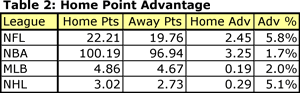
From a points per game perspective, NFL home teams have the biggest advantage. It works out to almost a 6% increase for the home team in terms of advantage in relation to total points per game. It’s unclear why this doesn’t translate to a bigger home win percentage, but the NFL is second in that category, so maybe it has more to do with the characteristics of the NBA than it does with the NFL.

Regarding the NBA’s last place finish in this category, it sort of goes with the league’s reputation. They say that you don’t have to watch the first three quarters of a NBA game, because it will probably be close at some point in the fourth quarter. Momentum swings wildly in basketball, more wildly than in any other sport, and if a team gets complacent, its opponent will probably go on a run. So while a 3.25-point advantage is significant, it doesn’t seem like a lot given the total number of points scored per game. But it is.

The more I dig into this, the more I want to see how home field/court/ice advantage translates to the playoffs. It seems like focus and travel issues would be eliminated, and we might get a clearer picture of which sport has the biggest home field advantage.

But that’s another column for another time.

What do computers know anyway?

Before the World Series, ESPN.com hired a company to determine which team had the best probability of winning.

Unsurprisingly, the Rays came out on top.

Tampa Bay RaysWe previously employed our Diamond Mind simulation software to project the results of the League Division and Championship Series. In the American League, we projected the Rays to easily defeat the White Sox, most likely in four games, and the Angels to defeat the Red Sox, but only if they could win Game 1. In the NLDS, our simulations projected the Phillies to defeat the Brewers, most likely in four games, and the Dodgers to upset the Cubs. The Phillies and Rays easily dispatched their opponents in four games, the Dodgers did indeed upset the favored Cubbies, and the Red Sox won that crucial opening game and went on to eliminate the Angels.

As we noted in our previous articles for ESPN.com, luck plays an even greater role in a short series than the regular season, which itself can be rather unpredictable. With that caveat in mind, the results of our simulations project the Tampa Bay Rays to continue their “Cinderella” run and defeat the Phillies. In fact, Tampa Bay won over 71 percent of our 2,000 series simulations, the largest winning margin of any postseason projection we’ve done for ESPN.com.

Not a good start there, Diamond Mind.

« Older posts Newer posts »