Author: John Paulsen (Page 70 of 937)

Murphy to Celtics; Bibby to Heat


The top two teams in the East just got a little better.

Marc Stein tweeted that Murphy told him personally that he’s going to Boston.

Murphy helps take some of the sting out of the loss of Kendrick Perkins in the Jeff Green trade. Murphy can rebound and shoot the three, so he’ll help space the court for the Celtics and give Doc Rivers another capable crunch time option with a little more length than Glen Davis.

I’m surprised Murphy didn’t pick the Heat, who seemingly have more available minutes at center, though maybe he wanted to get back to his Irish roots. The C’s are also in line to talk to Corey Brewer after his surprising buyout by the Knicks. He’s considered an elite wing defender and his on/off stats at 82games back that up.

Meanwhile, Mike Bibby is reportedly heading to the Heat. He’s well past his prime, but he’s still an upgrade over Mario Chalmers and Carlos Arroyo. I’m not sure why Miami hasn’t played with a Wade/Miller backcourt much this season, though Miller has been pretty bad as he’s been working his way back from injury.

Bibby gives the Heat an experienced player who won’t be afraid of the moment. He’s a good shooter who should be able to take advantage of open shots created by LeBron and Wade’s penetration. Good signing by Pat Riley.

Is it too early for a fantasy football draft? I think not.

Philadelphia Eagles LeSean McCoy breaks free for a 9-yard gain with Houston Texans Shaun Cody in hot pursuit during third quarter Philadelphia Eagles-Houston Texans game action in Philadelphia at Lincoln Financial Field December 2, 2010. Philadelphia defeated Houston 34-24. UPI/Eileen Angelino

In an effort to keep my fantasy mind sharp during the doldrums of February and March, I decided to join one of FantasyFootballWhiz.com’s Draftmaster drafts. I am not part of the Invitational, but the same rules apply:

The drafts are being done so that the changes in fantasy value over the next 7 months can be tracked and debated by a strong group of very knowledgeable Fantasy Football players. These drafts will lead to a whole series of articles, debates, roundtables and podcasts that will allow the readers and listeners to get inside the heads of these select drafters.

Note that these are “drafts” and not “mocks”, as the leagues will be scored. Each team will select 16 players in the draft and no roster moves will be allowed once it is complete. They will be scored using a best-ball system, which basically means that each teams top scorers will be automatically used each week to provide their score. No setting lineups, no waivers and no trades, they are simply put, all about the draft.

The leagues will be using a standard PPR scoring system with 16 roster spots. Each week’s scores will be generated by the best lineup, which will consist of 1 QB, 2 RB, 3 WR, 1 TE, 1 K, 1 DEF, FLEX (RB, WR, TE). To maximize the usefulness of the draft results, teams will be allowed no more than one kicker and one defense.

The competition seems good. There are a number of other fantasy experts and enthusiasts in my league (#Draftmaster 19) that I recognize from my time spent on Twitter.

I thought it might be valuable for me to go over each pick after I make it, revealing the other players that I considered along with my reasoning behind picking the player that I did. You can check the updated draft report here. My username (and Twitter name) is @FantasyShrink.

I had the #6 pick overall, which this year turns out to be a pretty good spot to be. Let’s jump right in and discuss the first six rounds.

1.06: LeSean McCoy, RB
With Chris Johnson, Arian Foster, Adrian Peterson, Jamaal Charles and Ray Rice taken with the first five picks, I was left with a decision between Maurice Jones-Drew and LeSean McCoy. While I do like MJD, his knee injury has me a little worried and I’m not all that confident in the Jacksonville O-line. On the other hand, McCoy was actually RB3 (behind Foster and Darren McFadden) on a per game basis in PPR leagues because he catches so many passes (78 in 2010). His adjusted numbers (for bias due to strength of schedule) are a little better.

One mistake that I see fantasy owners often make is to overlook pass-catching RBs like McCoy (or Brian Westbrook before him) in PPR leagues. They’re looking at magazine or website rankings that aren’t intended for the PPR audience, and those always underestimate the value of a guy who catches a lot of passes out of the backfield.

Here’s a look at highlights from McCoy’s 2010 season. The kid is explosive.

Continue reading »

Dim-witted Nets fan pulls a Bartman

During Monday night’s Suns/Nets game, there was an incident when Steve Nash went to save a ball that was going out of bounds. As he attempted to make the save, a fan sitting courtside (wearing sunglasses, no less) reached out and hit the ball away. Here’s a snapshot of the play.

After the refs discussed the play, the ball was awarded to Suns, even though Corey Hart was seen celebrating his shady move. (Sorry, couldn’t resist.)

Way to hurt your team, buddy.

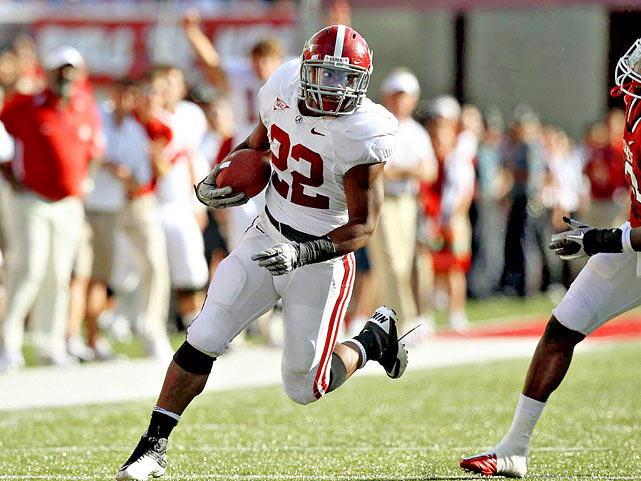
How worrisome is Mark Ingram’s 40-time?

Mark Ingram ran a 4.62 in the 40-yard dash at the NFL Combine, which is considered to be on the slow side of average. In fact, the average 40-time for a RB since 2005 is 4.56, and that’s from a sample size of 163 RBs over six years.

Seven of the top eight rushers in the NFL — Chris Johnson (4.24), Jamaal Charles (4.38), Adrian Peterson (4.40), Maurice Jones-Drew (4.39), Michael Turner (4.49), Steven Jackson (4.45), Rashard Mendenhall (4.41) — ran a sub-4.5 in the 40-yard-dash.

There was one notable exception, and it was the top rusher of 2010, Arian Foster. He reportedly ran a 4.69 at his pro day, which just goes to show it doesn’t take elite speed to rack up yards.

Still, with so many of the top rushers with good to excellent speed, isn’t it worrisome for a team thinking about drafting Ingram? I posed this very question to our NFL guru, Anthony Stalter, who currently believes Ingram will go #15 to the Dolphins, and here is what he said:

There are a lot of fans and draft pundits who get too caught up in 40-yard dash times. When I watched Ingram last year, I saw a physical back but one that has great short-area quickness when he went through holes. It’s true, he doesn’t have great top-end speed and he’ll never be a back that can rely on straight-line speed (which is what the 40-yard dash measures). That said, Ingram is a very solid prospect.

I think one of the most overrated factors when sizing up a running back prospect is speed, with vision being the most underrated attribute. When I watch Ingram play, he reminds me of Emmitt Smith. The former Cowboy didn’t have great straight-line speed like Chris Johnson or Adrian Peterson, but he was a natural runner with tremendous vision, instinct and balance. I’m certainly not suggesting that Ingram is the next Emmitt, but he bears a resemblance to Smith when he runs.

That said, as John has pointed out, speed kills and the proof is in the pudding. When all of the elite running backs in the league are running in the 4.3s or 4.4s (or in CJ’s case, a freakish 4.2), it makes you wonder whether or not Ingram can be an elite back in the NFL. Then again, I haven’t heard one analyst deem him an elite prospect, so it’s all relative. It would be great if every top 15 pick were elite, but the draft remains the ultimate crapshoot. If the Dolphins were to take him at No. 15 and he wound up being a solid feature back for the next 6-8 seasons, went to 1-2 Pro Bowls but was never considered an elite player, wouldn’t their selection of him be considered successful?

After running a 4.62 forty at the combine, there’s a good chance that Ingram could drop into the bottom half of the first round. I still like him at No. 15 to Miami, but some teams are overly reliant on the forty so I could see him potentially falling come April. It would be too bad too, because I think he’s a nice overall player who has worked hard to shed some weight in the offseason.

Foster is the exception that proves the rule: Speed kills. It’s great that the undrafted Foster landed in a good situation in Houston and made the most of it. But Ingram is widely regarded as the top prospect in a weak RB draft, and in all likelihood will be a first round pick. If the Dolphins are drafting him in the middle of the first, isn’t it their expectation that he’ll be elite? And what are his chances of becoming elite without top-end speed?

« Older posts Newer posts »