Month: April 2009 (Page 22 of 53)

Citifield and the new Yankee Stadium are expensive. Plus, a ballpark is a place for baseball

http://newyork.yankees.mlb.com/images/2009/04/16/FapduTOb.jpg

Sports Illustrated’s Norman Chad has a new column up about New York’s new ballparks:

New York, the most sophisticated sports town in Sports Nation, brings us two spectacularly expensive new stadiums this month — rent-free and property tax-free for the Mets and the Yankees — largely subsidized by public money on city-owned land.

The Mets’ new Citi Field, a.k.a. Belly-Up Ballpark, cost $850 million.

The new Yankee Stadium — boy, that old Yankee Stadium was a real stinker, eh? — cost $1.5 billion.

Amazingly, in a city faced with myriad budget problems, the Mets and the Yankees not only successfully solicited public financing, both clubs came back with their hand out a second time — and got more money.

Schools? No money.

Subway? No money.

Stadiums? How much do you need? Thank you sir, may I have another.

Sports fans have been faced with a lot of stadium changes in recent years. I for one never got a chance to see a game in Tigers Stadium, but rather enjoyed the spacious Comerica Park (I even rode the carousel once!). It’s great to be able to go into some of the nation’s new sports arenas and let yourself be distracted by all the glitzy new opportunities to forget that the reason you came there was to watch sports.

The onus of blame too, is not even on the owners of teams like the Yankees, Mets, and anybody else looking to cash in on public money. They’re greedy. Surprise, surprise. Why wouldn’t they be? They’re running a business. The politicians with the power to stop or confound their attempts to exploit the public are the people that it is necessary to get angry at.
Continue reading »

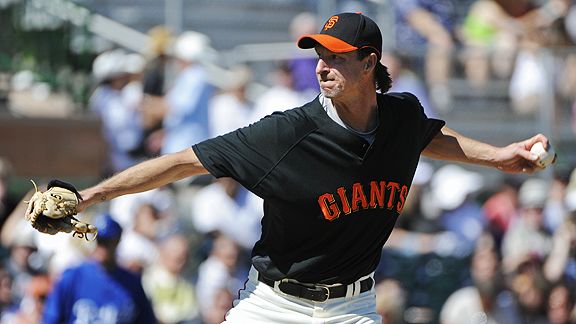
Randy Johnson pitches no-hitter through seven

Today we got more proof of the beauty behind an athlete’s battle against time. Last week, I wrote about Tom Glavine and a shoulder injury which may end his 22 year career. On the other side of the coin, there’s news today about an even older pitcher still getting the job done. As reported on Yahoo! Sports:

Johnson took a no-hitter into the seventh inning against his former team, and the San Francisco Giants held on to beat the Diamondbacks 2-0 on Sunday.

“Sometimes you have to put blinders on when it comes to certain teams,” Johnson said. “I just wanted to pitch well. It’s nice to go out there and feel like I’m contributing after the last two starts.”

Johnson, who allowed one hit in seven innings, was perfect through four. He faced the minimum through six and stranded Augie Ojeda at third base after the shortstop doubled to open the seventh.

A no-hitter through seven is nothing to scoff at, even if it did happen against a team not especially known for their hitting. It’ll be interesting to see how the now 1-2 record of Johnson grows, and how soon it’ll be before he reaches his 300th win (his win today puts him at 296). Again, from Yahoo! Sports and Brian Wilson, one of Johnson’s Giants teammates:

“It was beautiful,” Wilson said. “It was a nice day and Randy was out there dominating. He proved he can still do it.

“You watch him working the hitters, working the count and you realize not all of us can go out there and do that.”

I’ve never been much of a Randy Johnson fan, but regardless of what team he’s on now I think it’s worth our while to keep an eye on a future hall-of-famer before he’s finished actively playing ball.

Sixers shock Magic

The Philadelphia 76ers were down by 14 points heading into the fourth quarter, and they managed to outscore Orlando 35-19 in the final period to spring the upset. Andre Iguodala is a difficult matchup for Hedo Turkoglu, but with time running down in regulation, the Turkish forward forced the “new AI” into a tough shot, but Iguodala nailed it to give the Sixers the lead for good, 100-98. On the previous possession, Donyell Marshall hit a HUGE three-pointer (with 0:34 to play) to tie the game at 98-98. (Truth be told, I didn’t even realize that Marshall was still in the league.)

How did Orlando lose this game? Dwight Howard had 31 points and 16 rebounds, but Turkoglu and Rafer Alston combined to shoot just 7 for 23 from the field. Three-point shooting was the difference — Orlando shot 5 of 18 (28%) from long range while the Sixers knocked down 7 of 12 (58%) attempts. Iguodala had a great game, posting 20 points, eight rebounds and eight assists. Lou Williams pitched in with 18 points.

The Magic miss Jameer Nelson. Rafer Alston is a serviceable replacement, but he’s no Jameer. Rashard Lewis needs to play better as well. Fifteen points, three rebounds and three assists is a decent line, but not for a guy making more than $17 million per season.

Writer wants little leaguers to hit with baguettes

stick

Bob Klapisch from NorthJersey.com feels that aluminum bats should be banned from little league baseball in the state of New Jersey.

So when does common sense finally kick in? That’s the question we should be asking as Little League and youth baseball starts up this month – with thousands of kids armed with aluminum bats. This practice isn’t just dangerous; it’s our failing as adults.

There’s a bill sitting in the State Legislature calling for the abolition of metal bats in all youth-oriented games. As of now, it’s motion-less – no buzz, no hearings, no vote scheduled. The powerful aluminum-bat cartel appears to have won the war in New Jersey, which is an outrage to the family of Steven Domalewski, the Wayne youth who was permanently disabled after taking a line drive in the chest three years ago.

It’s time our representatives take a lesson from James Oddo, the Minority Leader in the New York City Council. Oddo single-handedly banned aluminum in New York’s high schools in 2007. He took on the industry and, incredibly, beat them. How? By calling out the greed that puts our kids at risk.

So far, the cartel has beaten back challenges in every state except North Dakota. They’ll tell you aluminum saves money (and who isn’t vulnerable to that sales pitch these days?). They’ll tell you aluminum gives every kid a chance to be a slugger, thereby increasing interest in the sport. And most disingenuous of all, they’ll say aluminum is about choice, and what’s more American than freedom of choosing your sporting weapon?

Come on, dude.

Klapisch uses the case of Steven Domalewski who was permanently disabled after taking a line drive to the chest that was hit off an aluminum bat. I’m sure there are many cases of injury caused by balls hit of aluminum bats: Ricky should’ve worn his cup at shortstop and Jake shouldn’t have been picking dirt in left field during that pop fly. Not two weeks ago, Giants pitcher Joe Martinez took a brutal line drive off his head from a wood bat. Freak accidents can happen at any level in baseball because the object of the game is to hit a hard ball thrown by a pitcher at people. The reason why little leaguers don’t use wood bats is because they’re incredibly heavy. Kids don’t have the same upper body strength as a guy like Manny Ramirez, an obvious trait that Klapisch fails to believe.

Look, even if it went into law that kids will now use custom-sized wood bats, unfortunate accidents would continue to happen because that is the nature of the game. You can’t convince me that the ratio of of injury is higher in little league baseball than it is in football, soccer, basketball, and hockey because of aluminum bats. Sports are physical, and there is always the risk of experiencing enormous physical pain no matter what equipment one uses.

Also, I love how he refers to Louisville and Easton as the aluminum bat cartel.

Does the 500 home run club still mean anything?

Jeff Passan from Yahoo! Sports thinks that, with Gary Sheffield’s recent admittance, the 500 home run club has lost the reverence it used to command.

And yet here Sheffield is, the club’s 10th member in the last 11 years after the game’s first 120 years produced 15. Of the 10 to reach the milestone since 1999, six bathe in steroid suspicion: Sheffield (admitted but said it was inadvertent), Rafael Palmeiro (tested positive), Alex Rodriguez (tested positive), Barry Bonds (duh), Mark McGwire (visual and documented evidence) and Sammy Sosa (visual evidence).

Which either makes the accomplishments of the other four – Ken Griffey Jr., Jim Thome, Manny Ramirez and Frank Thomas – all the more impressive or makes the inner cynic mistrust the veracity of anyone’s statistics.

“If anybody questions 500,” Sheffield said, “tell ‘em to go try it.”

It’s not questioning the accomplishment, per se. To hit 500 home runs takes innate aptitude and cultured longevity. Some home run hitters bomb away for a few years and flame out. Others are very good for a very long time, and that’s still not enough for 500. Sustained greatness is the ultimate testament in baseball, and prior to 1999, the 500-home run club embodied it.

Carlos Delgado makes a good point in a quote from the article, saying that players these days are bigger, have better equipment, better training, and play in smaller ballparks. He’s dead on, but Passan is stressing that the 500 club has been tainted by its steroid users.

Personally, I accepted the fact a long time ago that the 500 home run milestone was a dubious achievement given the bloated statistics from guys like Bonds, Sosa, and McGwire. True, the home run does carry a lot of weight in baseball. Not only does it have the power to win games, but it can bring a stadium alive as well as silence thousands. While ballplayers like Ryan Howard and Adam Dunn deserve praise for their ability to countlessly knock the guts out of a baseball, I’ve always admired guys like Ken Griffey Jr. who could do the same while also winning gold gloves at their position. That’s why Willie Mays, Hank Aaron, and Griffey will be remembered as some of the greatest all-around players the game has ever seen, instead of just average athletes with a killer swing.

« Older posts Newer posts »